Runway AI Review 2026: Pricing, Gen-4.5 Features & Best Alternatives
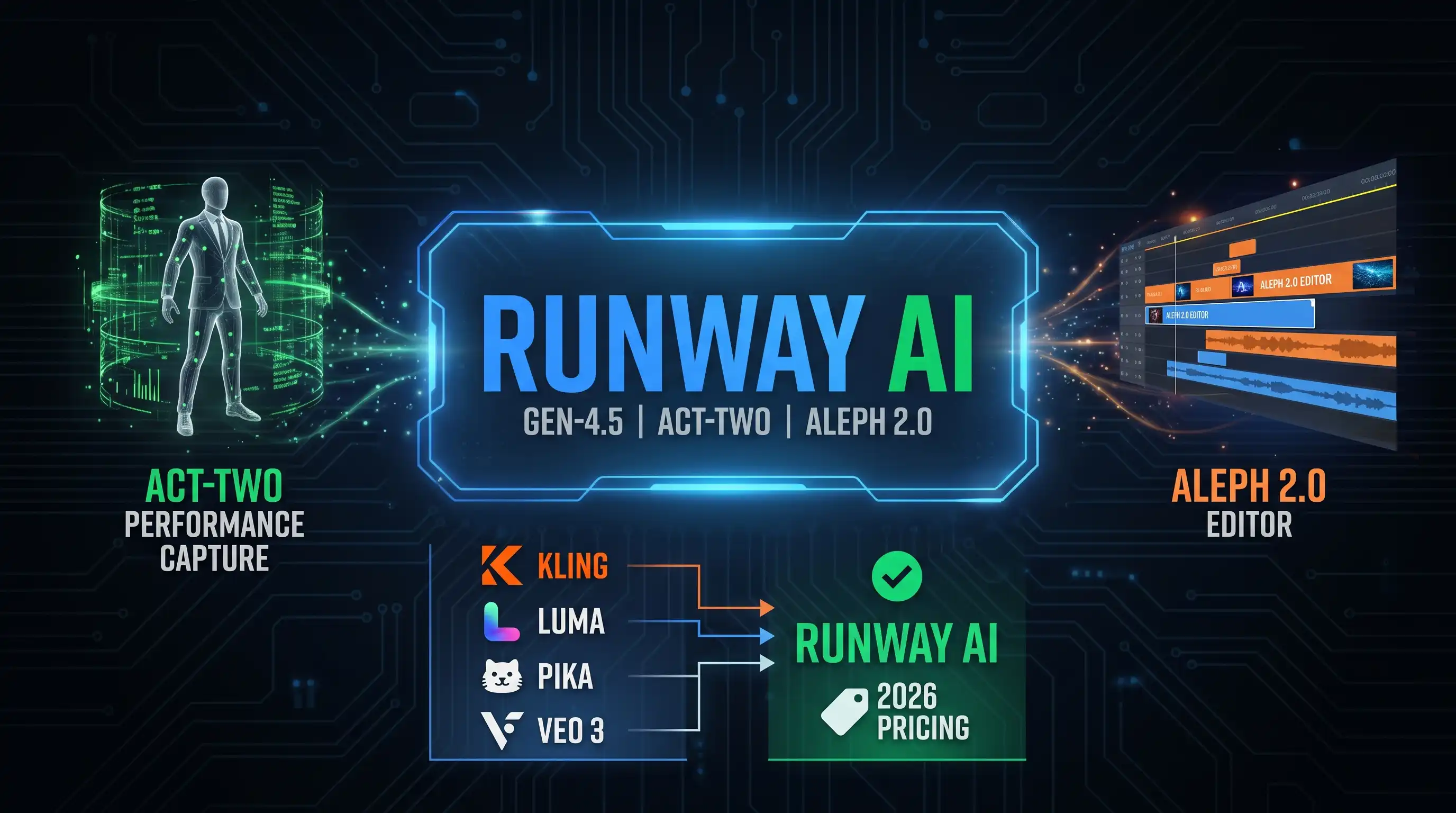
Runway AI is a professional video generation and editing platform built around its Gen-4.5 model, Act-Two performance capture, and the new Aleph 2.0 editor. Plans run from a free 125-credit trial to Max at $76/month (billed annually, 9,500 credits). It's the strongest pick for real editing control, but Kling and Luma are cheaper for casual testing.
Runway AI's Gen-4.5 model, Act-Two performance capture, and new Aleph 2.0 editor explained -- with real 2026 pricing and an honest comparison against Kling, Luma, Pika, and Veo 3.
Is Runway AI worth paying for in 2026?
Runway is one of the few AI video platforms built for actual production work rather than one-off social clips. Its Gen-4.5 model generates high-consistency video from text or images, Act-Two transfers a real performance onto an AI character, and a new Aleph 2.0 editor (launched May 21, 2026) can restyle, relight, or re-shoot existing footage using plain instructions -- without regenerating the whole clip from scratch.
Pricing runs from a watermarked free tier up to $76/month (billed annually) for the Max plan, which replaced Runway's old "Unlimited" tier earlier in 2026. Below, we break down every plan, what changed, and how Runway actually compares to Kling, Luma, Pika, and Google's Veo 3 -- all of which you can now generate from without leaving Runway's own workspace.
Runway AI Pricing in 2026
Runway's Gen-4.5 model costs 12 credits per second of generated video, which is the number to keep in mind when comparing plans -- a lot of older reviews still quote a higher, outdated rate.
| Plan | Price (annual) | Credits / month | Approx. Gen-4.5 video | Key limits |
|---|---|---|---|---|
| Free | $0 | 125 one-time | ~10 seconds | Image-to-video only, watermarked, 3 projects |
| Standard | $12/mo ($15 monthly) | 625 | ~52 seconds | No watermark, unlimited projects, priority queue |
| Pro | $28/mo ($35 monthly) | 2,250 | ~3 minutes | Commercial rights, unlimited storage |
| Max | $76/mo ($95 monthly) | 9,500 | ~13 minutes | On-demand generation, 1-month credit rollover, early model access |
| Enterprise | Custom | Custom | Custom | SLA, dedicated support |
The Max plan is the one thing that changed most in 2026: it replaced the old Unlimited tier, swapping a slower "Explore Mode" queue for on-demand generation and more than four times the monthly credits. Unused Max credits now roll over for one additional month rather than resetting -- Standard and Pro still reset monthly.
What's new: Gen-4.5, Act-Two, and Aleph 2.0
Gen-4.5 is Runway's flagship model, and reviewers consistently rank its visual quality and character consistency ahead of the earlier Gen-3 generation -- the same character or product now holds its appearance across multiple shots instead of subtly drifting between generations.
Act-Two is performance capture: you record yourself on camera, and Runway maps your facial expressions and body movement onto a generated or animated character. It's the closest thing to real acting direction currently available in a consumer AI video tool.
Aleph 2.0, released alongside a new Edit Studio interface, edits footage you already have rather than generating from nothing -- changing camera angles, relighting a scene, or removing and restyling specific elements with a written instruction instead of a manual VFX pass.
Runway also now licenses in third-party models -- Kling 3.0, Veo 3.1, and Seedance 2.0 -- directly inside its own workspace, so you can compare outputs from several leading video models without paying for separate subscriptions to each one.
Runway vs Kling vs Luma vs Pika vs Veo 3
None of these tools is universally "best" in 2026 -- each one wins on a different job.
| Tool | Best for | Free tier | Weak point |
|---|---|---|---|
| Runway | Ad-grade editing control, Act-Two, Aleph 2.0 | 125 one-time credits, watermarked | Credits burn fast at 12/sec |
| Kling AI | Cheap testing, native 4K, lip-synced audio | 66 credits/day -- highest free quota available | Editing tools far behind Runway |
| Luma AI | Fast, natural motion, image-to-video | Real recurring free tier | Less production/editing depth |
| Pika | Fastest, cheapest iteration | Free credits, fast turnaround | Weakest at long-form realism |
| Google Veo 3 | Native audio generation with the video itself | Limited trial via Google AI Pro | Full access needs a $249.99/mo Ultra plan |
If editing an existing shot -- not just generating a new one -- is the actual job, Runway's Aleph 2.0 and Act-Two don't have a direct equivalent yet on Kling, Luma, or Pika. If the job is cheap, high-volume experimentation before locking a final cut, Kling's 66 free daily credits make it hard to beat.
Runway pros and cons
Pros:
- Deepest editing toolkit of any mainstream AI video platform -- Act-Two and Aleph 2.0 go beyond generation into real post-production
- Access to Kling 3.0, Veo 3.1, and Seedance 2.0 inside one workspace, instead of separate subscriptions
- Commercial usage rights included from the Standard plan up
- Gen-4.5 output quality and character consistency lead most competitors for complex, multi-shot scenes
Cons:
- At 12 credits per second, Standard's 625 monthly credits cover under a minute of Gen-4.5 footage total
- Free plan is image-to-video only and watermarked -- no real free tier for text-to-video
- More expensive per generation than Kling or Pika for casual, high-volume testing
- Steeper learning curve than one-click competitors, given the depth of the editing tools
Is Runway AI worth it in 2026?
Runway is worth paying for specifically when editing control matters as much as generation -- filmmakers, agencies, and motion designers who need to reshoot a camera angle, relight a scene, or transfer a real performance onto a character get tools here that Kling, Luma, and Pika simply don't offer yet. For that audience, Pro at $28/month is the realistic entry point once the free tier's watermark and image-to-video limit stop being workable.
It's a weaker choice for casual use or first-time experimentation with AI video. Gen-4.5's 12-credit-per-second cost means Runway's own free and Standard tiers run out fast, and Kling's 66 free daily credits or Pika's cheaper iteration loop will teach the same fundamentals for less money before committing to a paid Runway plan.
Frequently Asked Questions
Is Runway AI free to use?
There's a free plan with 125 one-time credits, limited to image-to-video generation with Gen-4 Turbo, watermarked output, and 3 video projects. It's enough to test the workspace, not for ongoing use.
How much does Runway cost in 2026?
Standard is $12/month (annual billing, $15 monthly) with 625 credits. Pro is $28/month ($35 monthly) with 2,250 credits. Max -- which replaced the old Unlimited plan in 2026 -- is $76/month ($95 monthly) with 9,500 credits and one-month credit rollover. Enterprise pricing is custom.
What is Aleph 2.0?
Aleph 2.0 is Runway’s AI video editor, launched May 21, 2026 alongside a new Edit Studio interface. It edits footage you already have -- changing camera angles, relighting a scene, or removing and restyling elements -- from a written instruction, rather than generating a new clip from scratch.
What is Act-Two?
Act-Two is Runway's performance capture tool. You record yourself on camera, and it transfers your facial expressions and body movement onto a generated or animated character.
Does Runway include Kling or Veo?
Yes. Runway now licenses third-party models -- Kling 3.0, Google's Veo 3.1, and Seedance 2.0 -- directly inside its own workspace, alongside its own Gen-4.5 model.
Is Runway better than Kling or Luma?
For editing-heavy, production-grade work, yes -- Act-Two and Aleph 2.0 have no direct equivalent on Kling or Luma yet. For cheap, high-volume testing or fast natural motion, Kling and Luma are both more cost-effective than Runway.
Do unused Runway credits roll over?
Only on the Max plan, where unused credits roll over for one additional month. Standard and Pro credits reset monthly with no rollover.
⭐ User Reviews
Be the first to review!