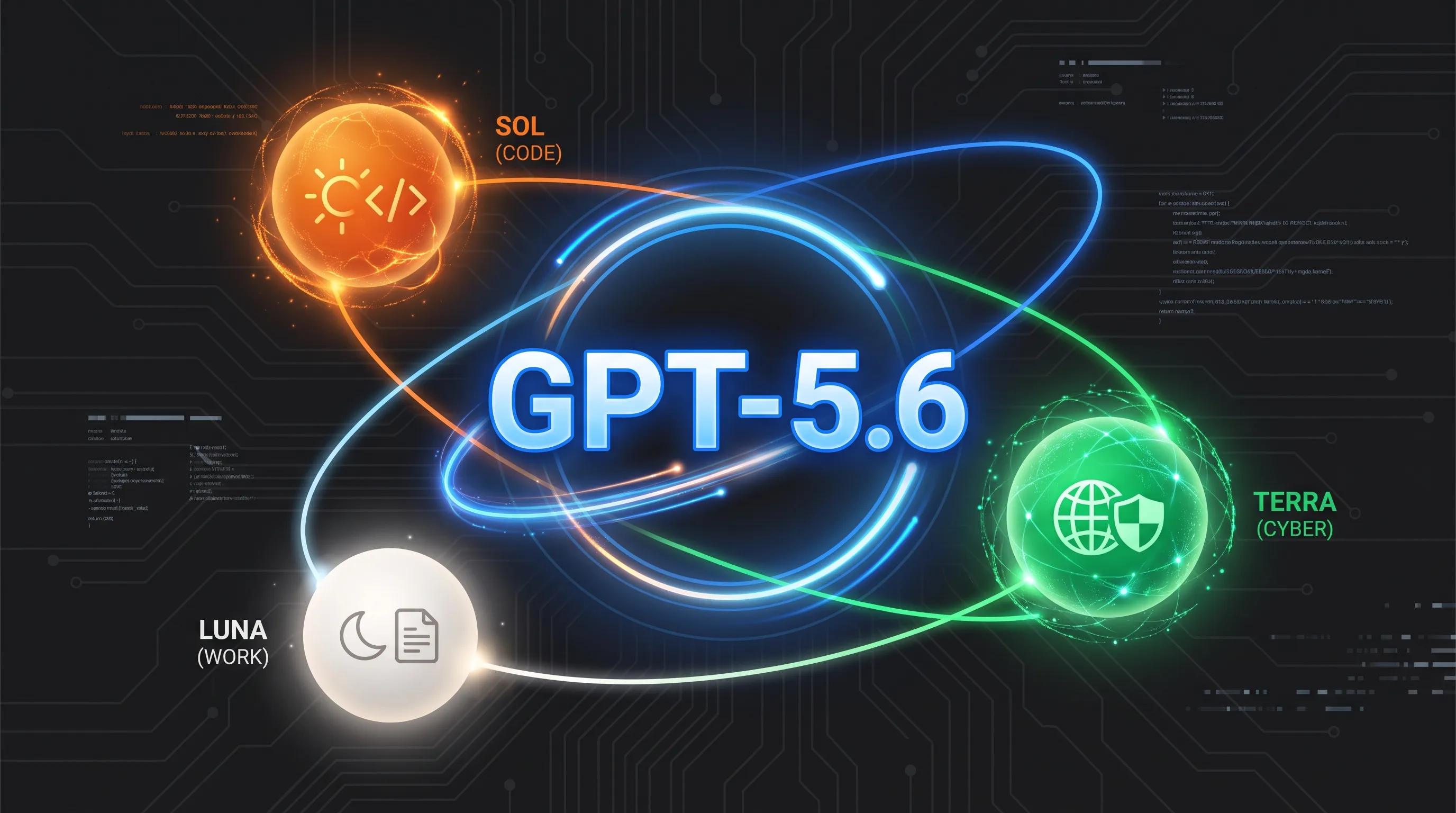
OpenAI vient de publier GPT-5.6 après un déploiement inhabituel examiné par le gouvernement – une famille à trois niveaux conçue pour le codage, la cybersécurité et le travail quotidien. Voici ce qui a réellement changé.
GPT-5.6 Just Launched: Sol, Terra, and Luna Explained
GPT-5.6 went live for everyone on July 9, 2026 — but the way it got there was more unusual than the model itself. OpenAI didn't just ship it; the release was delayed by a first-of-its-kind U.S. government safety review before the public ever got access.
Why the Delay Happened
OpenAI first previewed GPT-5.6 on June 26, but instead of a normal public rollout, access was limited to around 20 government-approved partner organizations. The reason was cybersecurity: GPT-5.6's strongest model showed frontier-level capability in vulnerability research, which was serious enough that the U.S. government asked OpenAI to hold broad release until a safety review cleared it. That review moved faster than expected, and general availability opened up on July 9.
Meet the Three Models
GPT-5.6 isn't a single model — it's a family of three, each aimed at a different budget and use case.
Sol — the flagship
Sol is OpenAI's most capable model to date, tuned for coding, scientific reasoning, and cybersecurity work. It introduces a new "ultra" mode that can coordinate multiple sub-agents working in parallel to finish complex, multi-step tasks faster than a single model working alone.
Terra — the balanced option
Terra sits in the middle, aiming for everyday production work at roughly half the cost of the previous generation's comparable model, without a major drop in quality.
Luna — the budget workhorse
Luna is built for high-volume, simple tasks where cost per request matters more than squeezing out maximum intelligence.
How It Performs
On coding-specific benchmarks, Sol set a new state-of-the-art score while using under half the output tokens and roughly a third of the cost compared to Anthropic's top coding model at the time. Independent early testers have been split on which model "feels" smarter day to day, with some preferring Anthropic's model for raw creative reasoning and others favoring GPT-5.6 for consistency on everyday, practical tasks.
Pricing Breakdown
| Modèle | Entrée (par 1M jetons) | Sortie (par 1M jetons) | Idéal pour |
|---|---|---|---|
| Sol | 5 $ | 30 $ | Les tâches les plus complexes |
| Terra | 2,50 $ | 15 $ | Travail de production quotidien |
| Luna | 1 $ | 6 $ | Tâches simples à fort volume |
Note: these are launch-day prices. Terra and Luna were cut on July 30, and Sol was cut on August 21 -- see the full updated pricing breakdown for current rates.
New Alongside the Launch: ChatGPT Work
OpenAI also introduced ChatGPT Work, an agent-style tool built for longer, multi-step workplace tasks — pulling context from your existing tools to turn scattered notes and drafts into finished documents, spreadsheets, or presentations. It's rolling out first on desktop, with mobile and web access following shortly after.
Where You Can Access GPT-5.6 Today
Sol is available in ChatGPT through reasoning settings on eligible paid plans, while the standard fast-response mode still defaults to the previous generation. Terra and Luna are accessible through ChatGPT Work, Codex, and the OpenAI API, depending on your plan. GPT-5.6 is also becoming the preferred model inside Microsoft 365 Copilot across Word, Excel, and PowerPoint.
Should You Switch?
If you're currently on GPT-5.5 or a comparable model, there's no urgent need to migrate every workload on day one. A more practical approach: test Luna or Terra on your simpler, repetitive tasks first, since the cost savings there are the most immediate and lowest-risk win, and reserve Sol for the complex work that actually needs frontier-level reasoning.
Questions fréquentes
What's the difference between GPT-5.6 Sol, Terra, and Luna?
Sol is the most capable and most expensive, built for complex reasoning, coding, and cybersecurity work. Terra balances cost and capability for everyday tasks. Luna is the cheapest, designed for simple, high-volume workloads.
Why was GPT-5.6 delayed before its public release?
The U.S. government requested a safety review due to the model's advanced cybersecurity capabilities before allowing a broad public rollout.
Is GPT-5.6 available in regular ChatGPT conversations?
Sol est disponible pour les forfaits payants éligibles via les paramètres de raisonnement, mais GPT-5.5 Instant reste la valeur par défaut pour les réponses rapides standard. Les utilisateurs gratuits et déconnectés ne bénéficient actuellement pas de Sol.
Is GPT-5.6 better than Claude for coding?
It depends on the task. GPT-5.6 Sol leads on several coding benchmarks with lower cost and faster completion, though some users report Anthropic's top model performs better on complex creative reasoning.
⭐ Avis des utilisateurs
Soyez le premier à laisser un avis !