Claude Code Pricing 2026: Pro, Max, Ultra and API Costs Explained
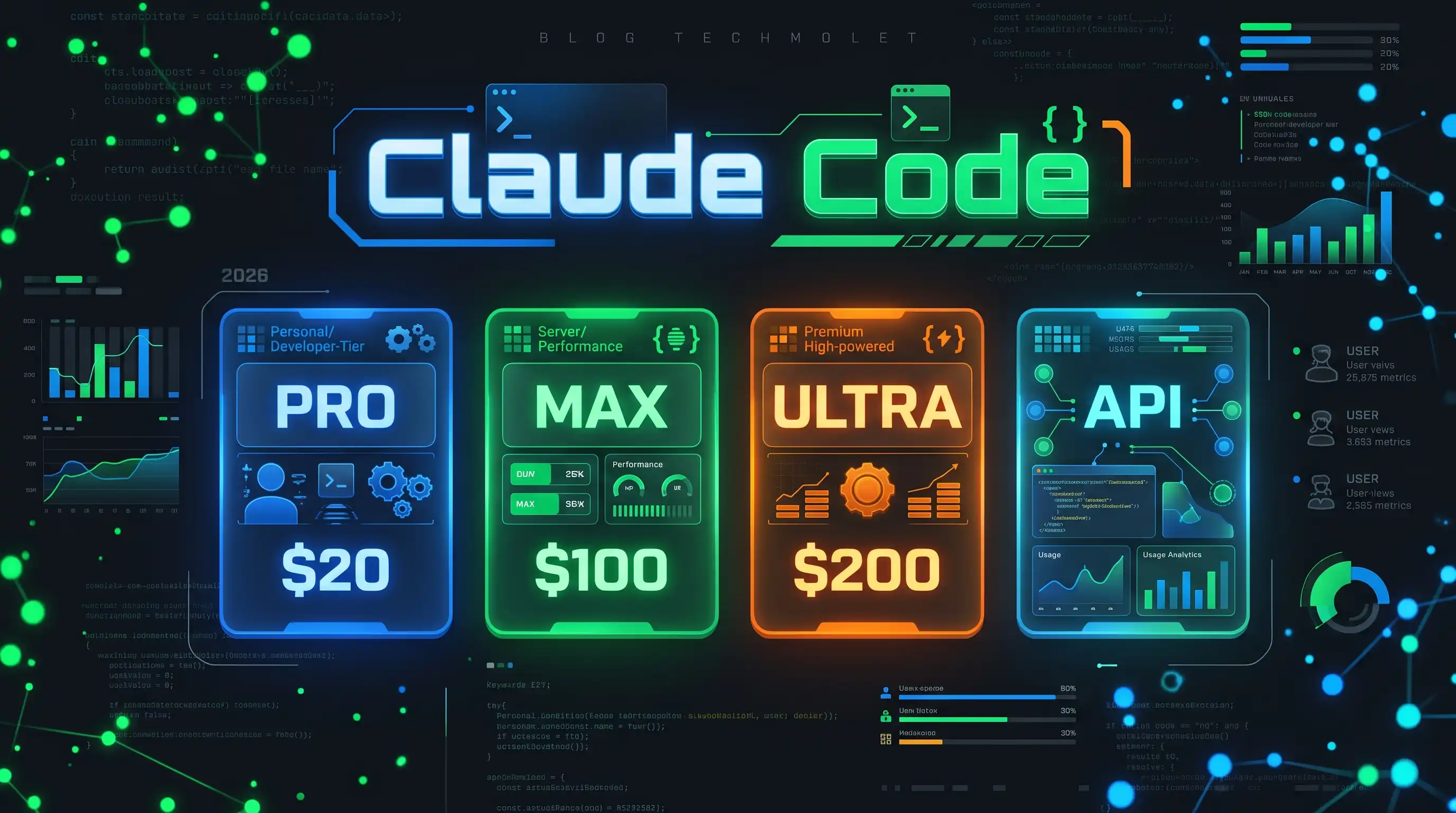
Claude Code is not free: it needs a paid Claude plan or API billing. Pro costs $20 a month ($17 billed annually), Max is $100, and Ultra is $200 (the renamed Max 20x). Team seats start at $20. API users pay per token, for example $2 input and $10 output per million tokens on Sonnet 5.5. Anthropic says the average developer spends about $13 per active day.
Claude Code isn't free. Here is what each plan costs in 2026 -- Pro $20, Max $100, Ultra $200, Team seats and per-token API rates -- plus how the usage limits work and how to cut your bill.
Claude Code Pricing 2026: Pro, Max, Ultra and API Costs Explained
Claude Code pricing comes down to two models: a flat monthly subscription (Pro at $20, Max at $100, Ultra at $200) or pay-as-you-go API billing, where Anthropic says the average developer spends about $13 per active day. It isn't included in the free Claude plan, so you need one or the other before you can use it.
This guide covers every plan, the per-token API rates, how the usage limits work, and what actually moves your bill. Prices below were checked against Claude's pricing page and Anthropic's Claude Code documentation on October 31, 2026. One change is very recent: Anthropic renamed the Max 20x plan to Ultra, at the same $200 price.
Claude Code Pricing at a Glance
The table lists every way to pay for Claude Code. Subscription plans include it inside the plan's usage allowance; the API and cloud routes bill per token instead.
| Plan | Price | Claude Code | Usage |
|---|---|---|---|
| Free | $0 | Not included | Limited, per 5 hours and per week |
| Pro | $20/month, or $17/month billed annually ($200 upfront) | Included | More than Free |
| Max | $100/month | Included | 5x Pro, per 5 hours and per week |
| Ultra | $200/month | Included | 10x Pro weekly; no 5-hour limit for verified accounts |
| Team Standard | $20/seat/month billed annually, $25 monthly | Included | Per-seat allowance |
| Team Premium | $100/seat/month billed annually, $125 monthly | Included | 5x a Standard seat |
| Enterprise | $20/seat/month billed annually, 20-seat minimum | Included | Usage billed at API rates |
| API / Console | Pay per token | Works | No plan cap; spend limits you set |
Is Claude Code Free?
No. Claude Code is not included in the free Claude plan. You need a paid subscription (Pro, Max, Ultra, Team, or Enterprise), or you can pay per token through the Claude Console API or through Amazon Bedrock, Google Cloud's Agent Platform, or Microsoft Foundry.
The cheapest legitimate way in is Pro at $17 a month on annual billing. If you only want to try it, the monthly Pro plan ($20) avoids the annual commitment. Be wary of guides that promise "free" access: they are usually describing a trial, a third-party wrapper, or a different tool.
Pro Plan: $20 a Month
Pro is the entry point for most solo developers. It costs $20 a month, or $17 a month if you pay $200 upfront for the year, and it includes Claude Code in the terminal and in supported editors.
Anthropic describes Pro usage only as "more than Free," not in token counts. In practice that means a rolling 5-hour window and a weekly window, both shared across every model and across Claude chat and Cowork. Light-to-moderate coding fits comfortably. Hours of agentic sessions on the strongest model will hit the ceiling, and when they do, you either wait for the reset or turn on usage credits (covered below).
Pro is also where most people should start. If you hit the limit regularly within a week, that is the signal to look at Max, not before.
Max and Ultra Plans: $100 and $200 a Month
Max costs $100 a month and gives five times Pro's usage, applied to both the 5-hour window and the weekly window. It's built for developers who run Claude Code for most of the working day.
Ultra costs $200 a month and is the new name for what used to be Max 20x. The price didn't change. What did change is how the limits are described: verified Ultra accounts have no 5-hour limit, and weekly usage is listed as 10x Pro. New Ultra accounts keep a temporary 5-hour cap until verification clears. Anthropic says the weekly limits themselves are unchanged, so treat the rename as a presentation change, not a cut or an upgrade.
Neither plan bills by the token. That is the main reason heavy users prefer them: a flat $100 or $200 is predictable, while the same work on the API can cost more, as the next sections show.
Team and Enterprise Seats
Team plans cover 2 to 150 seats. A Standard seat is $20 per month on annual billing ($25 monthly), and a Premium seat is $100 per month on annual billing ($125 monthly) with five times the usage of a Standard seat. Claude Code is included on both.
Enterprise starts at $20 per seat per month on annual billing with a 20-seat minimum, and usage is charged at API rates on top of the seat fee. That structure makes budgeting different from Team: the seat is cheap, but consumption is metered.
On both plans, each member draws from a per-seat allowance that resets on a rolling 5-hour window and a weekly window. Admins can turn on usage credits and set spend limits at the organization, group, or individual level, and Team admins can export a spend report to see who is using what.
Claude Code API Pricing: Pay Per Token
If you connect Claude Code to the Claude Console instead of a subscription, you pay per million tokens with no plan cap. Current list prices on Claude's pricing page are below.
| Model | Input (per 1M tokens) | Output (per 1M tokens) | Cache read |
|---|---|---|---|
| Fable 5.1 | $10 | $50 | $0.25 |
| Opus 5.5 | $4 | $20 | $0.20 |
| Sonnet 5.5 | $2 | $10 | $0.10 |
| Haiku 5.5 | $0.10 (up to 100K-token prompts) | $0.50 | $0.01 |
Batch processing is 50% cheaper, Opus 5.5 fast mode costs twice the standard price, and US-only inference adds 10%. Haiku 5.5 rises to $0.50 input and $2.50 output once a prompt passes 100K tokens.
A quick example shows the scale. A task that reads 1 million input tokens and writes 200,000 output tokens costs $4 on Sonnet 5.5 ($2 plus $2) and $8 on Opus 5.5 ($4 plus $4). Real sessions are cheaper than that arithmetic suggests because prompt caching bills repeated context at the cache-read rate, but they also run long, because Claude Code re-sends the whole conversation with every request.
Cloud routes work the same way. On Amazon Bedrock, Google Cloud's Agent Platform, or Microsoft Foundry, Claude Code is billed per token to your cloud account and you control spend through your cloud provider's budgets.
Subscription or API: Which Is Cheaper?
For most people who code with Claude every day, a subscription is cheaper, because Anthropic's own numbers put API-billed usage well above the flat plan prices. According to its Claude Code documentation, the average cost across enterprise deployments is around $13 per developer per active day, or $150 to $250 per developer per month, and 90% of users stay below $30 per active day.
Set that against the plans. $150 to $250 a month is more than Max ($100) and in the range of Ultra ($200), so a developer with average API-style usage would usually save money on a subscription, with the caveat that plans have usage windows and the API doesn't. At the other end, someone who uses Claude Code a few hours a week can spend far less than $20 on the API and may not need Pro at all.
The API makes sense in three situations: your company already bills Claude through a cloud account, you need to automate Claude Code in scripts or CI, or your usage is so occasional that a monthly fee is wasted. One trap to know about: if an ANTHROPIC_API_KEY environment variable is set, Claude Code can bill the API instead of using your subscription, so check which one you're signed in with.
How Claude Code Usage Limits Work
Subscription usage is governed by two windows: a rolling 5-hour window and a weekly window. Both are shared across all models, so you can't restore access by switching from Opus to Sonnet when you hit "You've hit your session limit" or "weekly limit." Only the model-specific messages (for example, an Opus limit) can be worked around by switching to another model family with /model.
How quickly you reach a limit depends on the model you use, how long your chats are, and how large your files are. Long sessions burn more than they appear to, because Claude Code sends your full conversation with every request. A first message after a break longer than the cache lifetime also reprocesses your whole context.
When you reach a limit, you have three options: wait for the reset (Claude Code can wait and continue the task automatically on recent versions), switch plans, or turn on usage credits. Usage credits let Pro, Max, and Ultra subscribers keep working past the allowance and are managed with /usage-credits, with an optional monthly spend limit so a runaway session can't surprise you.
To see where your usage goes, run /usage. On a subscription it shows plan usage bars and a breakdown of what counts against your limits, attributed to skills, subagents, plugins, and MCP servers, with recommendations for changes. The dollar figure in the Session block is an estimate for API users and isn't relevant to your subscription bill.
Hidden Costs: Why a Claude Code Bill Spikes
A session that has been open for hours can use far more of your limits than your activity suggests. Anthropic's documentation lists the usual causes, and most of them are about context rather than about how much you typed.
Long context. Claude Code re-sends the full conversation with every request, and each tool call triggers another request carrying that batch of results. Prompt caching bills that history at the cheaper cache-read rate, but a one-line question in a session that has been open all day still draws usage for the whole conversation.
Cache misses after a break. If you step away for longer than the cache lifetime, your first message afterwards reprocesses the entire context at full price. Compacting a very large context is itself a large request, because /compact has to read everything it summarizes.
Background and parallel work. Scheduled tasks fire on their interval even while the session is idle, and each one sends your full context. Subagents, workflows, and agent teammates each make their own requests on top of the main conversation, and every active teammate keeps consuming tokens until it exits.
Heavy defaults. Leaving Opus as the default model, or leaving extended thinking at a high effort on simple tasks, quietly multiplies output tokens. On the API, Anthropic points to long sessions that were never cleared and Opus left as the default as the usual reasons for unexpectedly high spend.
The fix is mostly habit. Run /usage at the prompt: it recommends a change for any behavior that accounts for 10% or more of your recent usage.
How to Cut Your Claude Code Bill
The same habits lower API spend and stretch a subscription's limits, because both depend on how many tokens Claude processes. These are the ones Anthropic's documentation puts first.
- Clear between tasks. Run
/clearwhen you switch to unrelated work. Stale context is re-sent on every later message. - Match the model to the job. Sonnet handles most coding tasks well and costs half as much as Opus per token. Keep Opus for architecture and multi-step reasoning, and use Haiku for simple subagent tasks.
- Lower the effort level. Extended thinking is billed as output tokens. Use
/effortto reduce it on routine work. - Use plan mode on big tasks. Press Shift+Tab to let Claude propose an approach before it edits, which avoids expensive rework.
- Keep CLAUDE.md short. It loads into every session. Move workflow-specific instructions into skills, which load only when invoked, and aim for under 200 lines.
- Be specific. "Add input validation to the login function in auth.ts" costs far less than "improve this codebase."
- Be careful with agent teams. Agent teams can use roughly seven times more tokens than a standard session in plan mode, because each teammate runs its own context window.
Claude Code vs Cursor, Copilot and Codex on Price
Claude Code competes mainly with Cursor, GitHub Copilot, and OpenAI Codex. On price alone, Claude Code sits in the middle to upper end: $20 gets you in, and the heavy tiers are $100 and $200.
Cursor's current individual plans run from a free tier through Plus at $8, Premium at $30, Super at $100, and Ultra at $200; our Cursor pricing breakdown explains what changed in October. GitHub Copilot has a free plan with paid tiers from $10 a month, and Codex is included with ChatGPT Plus at $20, with Pro tiers at $100 to $200.
The price tiers line up closely at $20, $100, and $200, so the decision is rarely about the sticker price. It's about workflow: Claude Code is terminal-first and agentic, while Cursor and Copilot live inside an editor. Our guide to the best AI coding assistants compares them on features, and if you want to understand the model behind it, see Claude vs ChatGPT.
Which Claude Code Plan Should You Choose?
Pick the cheapest plan that you won't hit the ceiling on within the first week. If you do hit it, move up one tier rather than guessing.
- Trying it or coding a few hours a week: Pro ($20 monthly, or $17 on annual billing).
- Coding with it most of the day: Max ($100).
- Running several sessions in parallel, or hitting the 5-hour wall on Max: Ultra ($200).
- A team that needs admin controls and spend reports: Team Standard or Premium seats.
- A company with contracted cloud spend or automation: API through the Console or your cloud provider.
Prices and limits change often in this category, so confirm on Claude's pricing page before you subscribe. For more coding tools and pricing breakdowns, browse the AI tools directory or our latest guides and comparisons.
Frequently Asked Questions
Is Claude Code free?
No. Claude Code is not included in the free Claude plan. You need a paid plan (Pro, Max, Ultra, Team, or Enterprise) or API billing through the Claude Console, Amazon Bedrock, Google Cloud's Agent Platform, or Microsoft Foundry.
How much does Claude Code cost per month?
On a subscription, Pro is $20 a month ($17 billed annually), Max is $100, and Ultra is $200. On the API you pay per token; Anthropic says the average cost is around $13 per developer per active day, or $150 to $250 per developer per month, with 90% of users under $30 per active day.
Is Claude Pro enough for Claude Code?
For light to moderate coding, yes. Pro usage is shared across a rolling 5-hour window and a weekly window, so long agentic sessions on a strong model can hit the limit. If you reach it regularly within a week, move up to Max rather than guessing.
Is the API cheaper than a subscription?
Usually not for daily use. At Anthropic's own average of $150 to $250 per developer per month, API spend exceeds Max ($100) and approaches Ultra ($200). The API wins for occasional use, automation in scripts or CI, or companies that already bill Claude through a cloud account.
What happened to the Max 20x plan?
Anthropic renamed Max 20x to Ultra and kept the $200 price. Verified Ultra accounts no longer have a 5-hour limit, and weekly usage is listed as 10x Pro. Anthropic says the weekly limits themselves are unchanged.
Can I use Claude Code through Amazon Bedrock or Google Cloud?
Yes. On Amazon Bedrock, Google Cloud's Agent Platform, or Microsoft Foundry, Claude Code is billed per token to your cloud account, and you manage spend with your cloud provider's budget controls.
User Reviews
Be the first to review!