GPT-6 Astra vs Sol vs Luna: Pricing, Differences and Which to Use
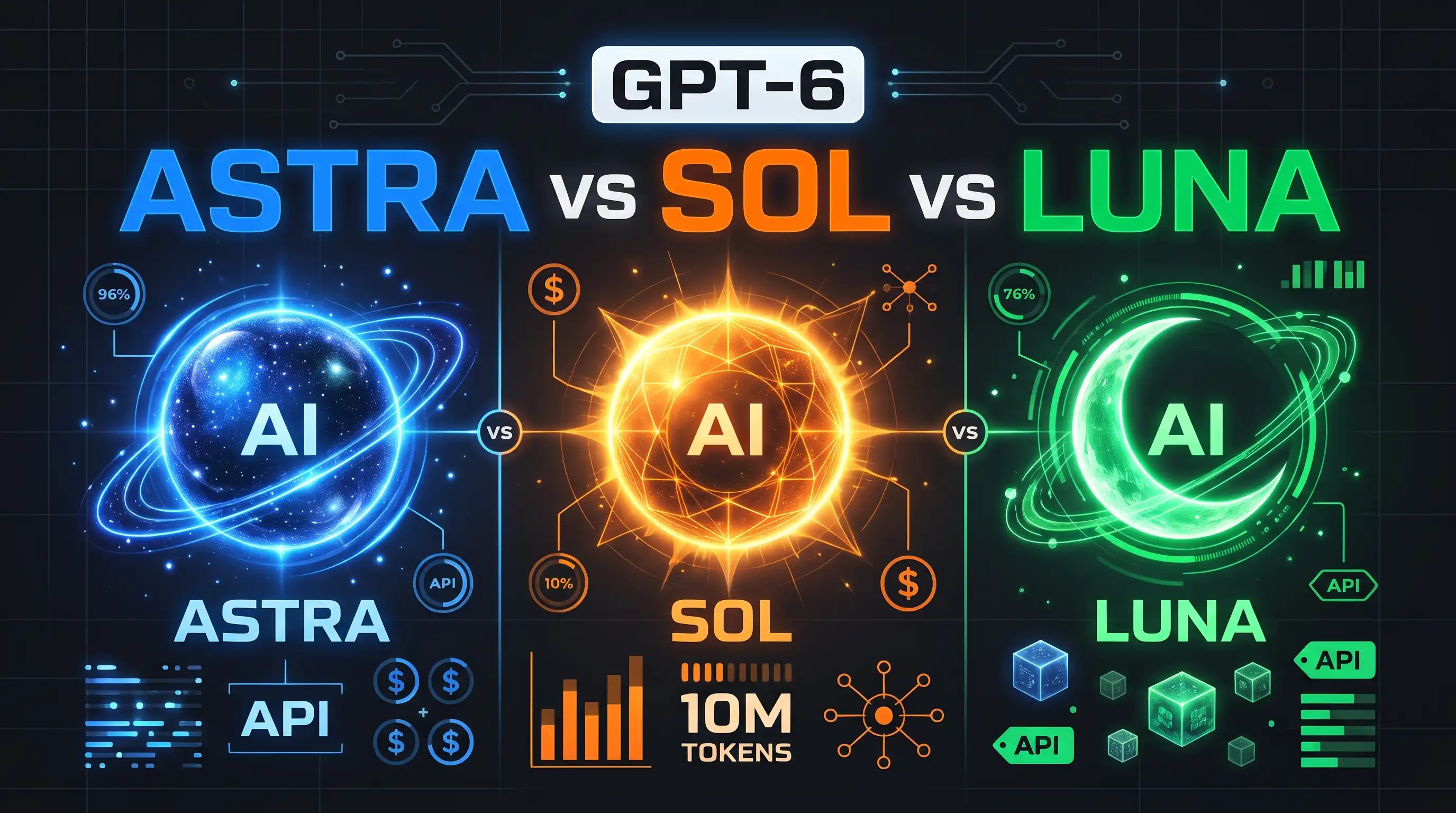
GPT-6 is OpenAI's current family: Astra (flagship, reported at $10/$50 per million tokens), Sol (everyday work, $2/$10) and Luna (high volume, $0.10/$0.50). Sol costs 20 times Luna and Astra costs 5 times Sol, so start with Luna, move failures to Sol, and keep Astra for the hardest work. In ChatGPT, Free and Go run Luna.
GPT-6 comes in three models: Astra, Sol and Luna. Here is what each costs, what changed from GPT-5.6, and how to pick without overspending.
GPT-6 Astra vs Sol vs Luna: The Short Answer
GPT-6 is OpenAI's current model family, and it comes in three sizes: Astra, Sol and Luna. Astra is the flagship for the hardest work, Sol handles everyday professional tasks, and Luna is the cheap, fast option for high-volume jobs. The price gap between them is large and predictable: Sol costs about 20 times Luna per token, and Astra costs about 5 times Sol. This guide shows what each model costs, what a real workload adds up to, what changed since GPT-5.6, and how to choose without overspending.
What Each GPT-6 Model Is For
Astra: the flagship
OpenAI unveiled Astra on September 3, 2026 as its most capable model, aimed at hard reasoning, coding, and tasks where the model has to operate a computer or browser. It reached paid users in a restricted form the next day. OpenAI has also warned about its cybersecurity capabilities, and the public version declines some security-related requests. Use it when a wrong answer is expensive.
Sol: the everyday workhorse
Sol launched on September 22, 2026 and brings much of Astra's style and reliability at a fifth of the price. OpenAI says GPT-6 Sol makes about half as many mistakes as GPT-5.6 Sol on its internal factuality evaluation, and that it improves on coding and computer use. A GPT-6.1 Sol update now also appears on ChatGPT's pricing page. For most professional work, Sol is the model to try first.
Luna: the high-volume tier
Luna arrived with Sol and is built for fast, clearly defined work: summarizing documents, extracting fields, answering quick questions, and classifying text at scale. It is also the model ChatGPT's Free and Go plans run, so it is the GPT-6 model most people actually use.
GPT-6 API Pricing
| Model | Input (per 1M tokens) | Output (per 1M tokens) | Source of the figure |
|---|---|---|---|
| GPT-6 Astra | $10 | $50 | Third-party trackers |
| GPT-6 Sol | $2 | $10 | Launch coverage |
| GPT-6 Luna | $0.10 | $0.50 | Launch coverage |
OpenAI also improved prompt caching: cached input reads get a 90% discount, which matters for agents that resend the same context again and again. OpenAI's own pricing page blocked our automated check, so treat the Astra figure as reported rather than confirmed and verify all three on OpenAI's site before you build a budget.
The 100x Ladder: What 10 Million Tokens Costs
Because the tiers scale so cleanly, you can estimate any workload in your head. Take an agent workflow that sends 10 million input tokens and 2 million output tokens a month:
| Model | Math | Monthly cost |
|---|---|---|
| Luna | 10 × $0.10 + 2 × $0.50 | $2 |
| Sol | 10 × $2 + 2 × $10 | $40 |
| Astra | 10 × $10 + 2 × $50 | $200 |
Astra is 100 times the cost of Luna for the same tokens. That does not make Astra a bad deal, because cost per token is not cost per finished task. If Sol needs five attempts to do what Astra does in one, Astra is already cheaper. If Luna gets the answer right on the first try, paying 100 times more buys nothing. The practical rule is to measure cost per finished task, using the same 20 to 50 real prompts on each tier.
A Simple Escalation Rule
- Start every new workload on Luna. If it passes your test prompts, you are done and the bill is tiny.
- Send only the failures to Sol. Most routine failures are fixed here for 20 times the price, on a small share of requests.
- Reserve Astra for the work where one wrong answer costs more than the model. Examples are production code changes, security reviews and long autonomous runs.
- Re-test when prices change. All three GPT-5.6 tiers were cut within weeks of launch, and OpenAI moves quickly.
What Changed From GPT-5.6
| Model tier | GPT-5.6 (after price cuts) | GPT-6 |
|---|---|---|
| Mid-tier (Sol) | $4 input, $20 output | $2 input, $10 output |
| Budget tier (Luna) | $0.20 input, $1.20 output | $0.10 input, $0.50 output |
| Flagship | Sol was the top tier | Astra added above Sol |
The names carried over but the roles shifted: in GPT-5.6, Sol was the flagship, while in GPT-6 it is the mid-tier and Astra sits above it. That is why older advice such as "Sol is for the hardest tasks" no longer applies. See our GPT-5.6 Sol price-cut breakdown for the earlier numbers.
Where You Can Use Each Model
| Plan | GPT-6 models listed on ChatGPT's pricing page |
|---|---|
| Free and Go | GPT-6 Luna |
| Plus | GPT-6.1 Sol, GPT-6 Astra, GPT-6 Sol and GPT-6 Luna |
| Pro | All of the above, with expanded or unlimited access where marked |
Developers can call Sol and Luna through the OpenAI API, and both also run in OpenAI Codex and ChatGPT Work. For consumer plans and what they cost, read our ChatGPT vs Claude vs Gemini guide, or the ChatGPT tool page.
How GPT-6 Compares With Claude and Grok
OpenAI says Sol matches or beats Anthropic's Claude Fable 5.1 on some benchmarks and that its Sol and Luna models beat Anthropic's top models, though the coverage we found gives no specific scores. Anthropic released Opus 5.5 the same day as Sol and Luna, and it reportedly beats Astra on some coding and knowledge-work tests. One comparison also puts Astra only a few points ahead of GPT-6.1 Sol on the Artificial Analysis index (56.9 against 54.5), which suggests the premium buys less than the 5x price gap implies. On price alone, xAI's Grok sits at $2 and $6 per million tokens, close to Sol (see our Grok 4.5 guide). Benchmarks are the vendors' own, so test on your tasks. Our Claude vs ChatGPT comparison covers the consumer side.
Which GPT-6 Model Should You Pick?
| If your job is... | Pick | Why |
|---|---|---|
| Summaries, tagging, data extraction at scale | Luna | Lowest cost, clear instructions |
| Writing, analysis, everyday coding | Sol | Strong quality at a fifth of Astra's price |
| Hard bugs, security review, long agent runs | Astra | Best reasoning when mistakes are costly |
| Just chatting in ChatGPT | Whatever your plan includes | Free and Go run Luna, Plus adds Sol and Astra |
To compare more assistants and coding tools, browse the AI tools directory or read Claude Code vs Cursor vs Codex.
Sources
Prices and plans checked on November 15, 2026. OpenAI's API pricing page blocks automated access, so confirm figures there:
Frequently Asked Questions
When was GPT-6 released?
GPT-6 Astra was unveiled on September 3, 2026 as a limited preview, with a public release to paid users in a restricted form the next day. GPT-6 Sol and GPT-6 Luna followed on September 22, 2026.
How much does GPT-6 cost?
Per million input and output tokens, GPT-6 Sol is $2 and $10 and GPT-6 Luna is $0.10 and $0.50, according to launch coverage. Astra is reported at $10 and $50 by third-party trackers, because OpenAI's pricing page blocked our automated check. Confirm on OpenAI's site before budgeting.
What is the difference between Astra, Sol and Luna?
Astra is the flagship for the hardest reasoning, coding and computer-use work. Sol is the mid-tier for everyday professional work and costs a fifth of Astra. Luna is the cheapest, built for fast, high-volume tasks with clear instructions such as summarizing and extracting data.
Is GPT-6 free in ChatGPT?
Partly. ChatGPT's pricing page lists GPT-6 Luna for the Free and Go plans, with unlimited text chats subject to abuse guardrails. Sol and Astra sit on paid plans such as Plus and Pro.
Is GPT-6 better than Claude?
It depends on the task. OpenAI says Sol matches or beats Claude Fable 5.1 on some benchmarks, while Anthropic released Opus 5.5 the same day and it reportedly beats Astra on some coding and knowledge-work tests. Run your own tasks on both before choosing.
Should I still use GPT-5.6?
For new work, GPT-6 is the better default: GPT-6 Sol and Luna launched at half the price of the GPT-5.6 versions, and OpenAI says Sol makes about half as many mistakes. ChatGPT's pricing page still lists GPT-5.6 models on paid plans for people who want them.
User Reviews
Be the first to review!