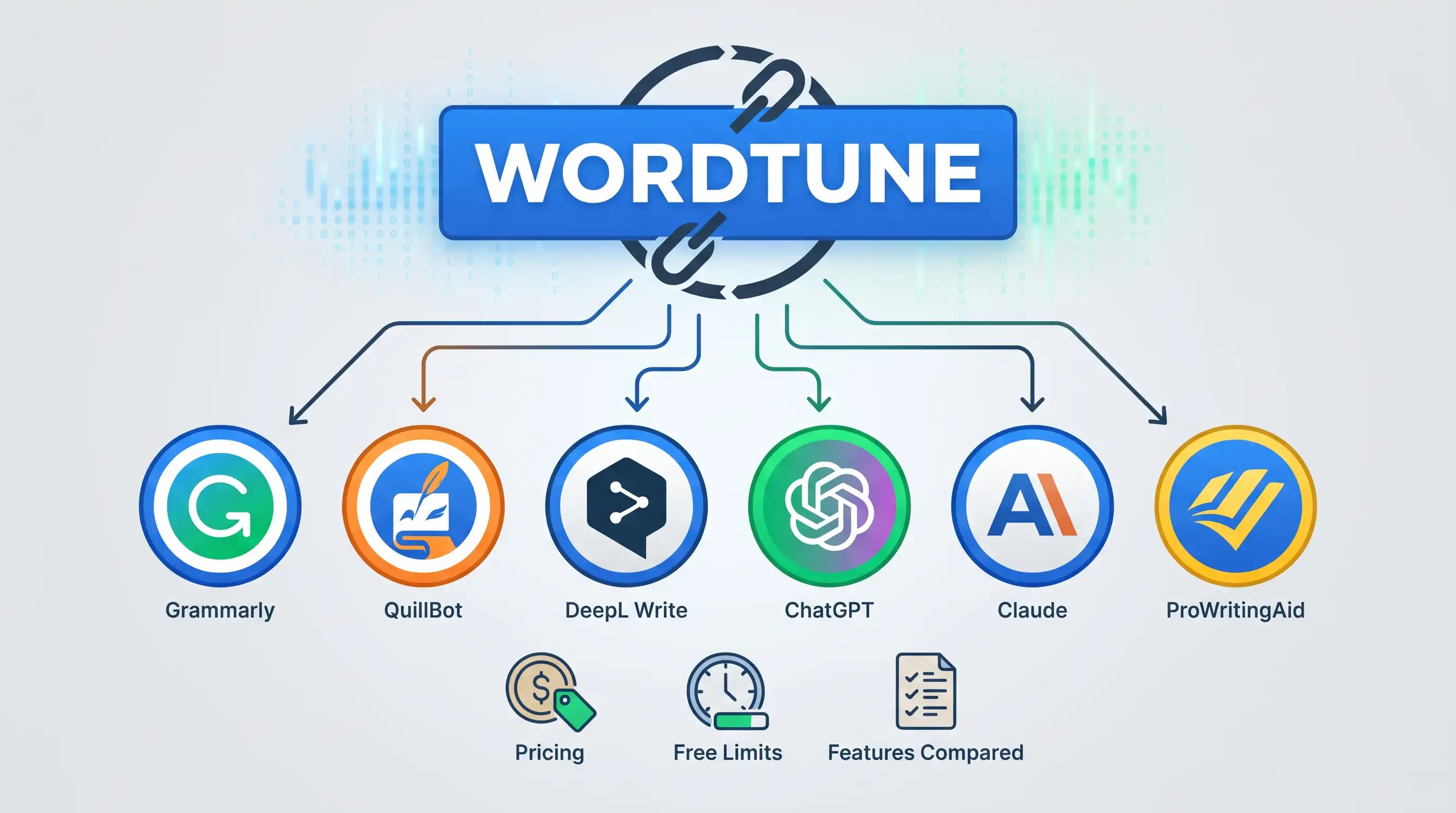
The best Wordtune alternative for most people is Grammarly, which adds grammar, tone, and plagiarism checks to rewriting from $12/month (billed annually). QuillBot is the closest match for pure paraphrasing, DeepL Write suits multilingual writers, and ChatGPT or Claude give the most flexibility if you're happy to write prompts. Wordtune's own plans run from $0 to $9.99/month.
Wordtune's free plan runs out fast and it only rewrites one sentence at a time. Here are 6 real alternatives -- Grammarly, QuillBot, DeepL Write, ChatGPT, Claude, and ProWritingAid -- compared on pricing, free-plan limits, and what each does better.
Wordtune Alternatives: 6 Best Options in 2026
Wordtune alternatives are worth a look if you've run into the free plan's daily cap, want grammar and plagiarism checks in the same tool, or simply need something that handles more than one sentence at a time. Wordtune is still a good sentence-level rewriter, and its plans are cheap, but it isn't the only way to polish your writing, and for some jobs it isn't the best one.
This guide compares six real options -- Grammarly, QuillBot, DeepL Write, ChatGPT, Claude, and ProWritingAid -- on pricing, free-plan limits, and what each one does better than Wordtune. Prices were checked against vendor pages in October 2026.
Why Look for a Wordtune Alternative?
Wordtune's free plan is the first thing most people outgrow. It allows 10 rewrites and AI suggestions per day and 3 AI summaries per month, with spelling and grammar checks unlimited. That is enough to test it, but a single long email can burn through the daily allowance in a few minutes.
The paid tiers lift the cap without costing much. Advanced is listed at $6.99 a month (about $4.89 on annual billing) for 30 rewrites a day and 15 summaries a month. Unlimited is $9.99 a month (about $6.99 annually) with no rewrite limit, and both paid plans include a 3-day free trial.
The other reasons people leave are about scope, not price. Wordtune rewrites the sentence you select; it doesn't draft an article from a brief, run a plagiarism check, or catch every grammar slip in a long document. If your work needs any of those, you'll want a second tool or a different one.
Wordtune Alternatives at a Glance
The table below puts the six options side by side. Free-plan limits and prices come from each vendor's pricing page where it was reachable, and from recent third-party trackers where it wasn't (QuillBot's page blocked automated access), so confirm the final price at checkout.
| Tool | Best for | Free plan | Paid price |
|---|---|---|---|
| Grammarly | Grammar, tone, and plagiarism in one place | Yes -- 100 AI prompts a month | Pro $12/month billed annually, $30 monthly |
| QuillBot | Paraphrasing whole paragraphs | Yes -- 125 words at a time | Premium about $8.33/month annually, about $19.95 monthly |
| DeepL Write | Writers working across languages | No Write Pro on the free plan | Write Pro add-on €6.99/month billed annually |
| ChatGPT | Flexible rewrites with custom instructions | Yes | See the ChatGPT tool page |
| Claude | Long documents and natural tone | Yes | See the Claude tool page |
| ProWritingAid | Long-form and fiction editing | Yes -- 500 words per suggestion | Premium $10/month billed yearly, $30 monthly |
| Wordtune (for reference) | Sentence-level rewrites | Yes -- 10 rewrites a day | Advanced from $6.99, Unlimited from $9.99 |
The 6 Best Wordtune Alternatives
Grammarly -- Best Overall Alternative
Grammarly is the best overall Wordtune alternative because it covers what Wordtune skips: grammar, spelling, tone detection, and plagiarism checks, alongside full-sentence rewrites. If grammatical correctness is your main worry, it does that job better than Wordtune, which concentrates on how a sentence sounds.
The free plan gives you spelling and grammar correction, tone detection, and 100 AI prompts a month. Pro costs $12 per member per month on annual billing, or $30 if you pay monthly, and raises the AI allowance to 2,000 prompts a month. It also adds full-sentence rewrites, fluency suggestions, plagiarism and AI-text detection, and inclusive-language suggestions.
Where it falls short: the monthly price is more than double Wordtune's top tier, and its rewrites can feel more conservative. If you want five bold alternative phrasings of one sentence, Wordtune still feels faster.
QuillBot -- Best for Paraphrasing Long Passages
QuillBot is the closest direct competitor to Wordtune, and it's stronger when you need to rework whole paragraphs rather than one sentence. You paste a block of text, choose a mode, and get a rewritten version with the changed words highlighted.
The free plan caps the paraphraser at 125 words at a time and offers only two modes (Standard and Fluency), which is tighter than most people expect. Premium removes that cap and unlocks the extra modes, a plagiarism checker, and an AI detector. Third-party trackers list it at about $8.33 a month on the annual plan ($99.95 a year) or about $19.95 on monthly billing; one report says the annual price doubled during 2025, so check it before you subscribe.
Pick QuillBot if you rewrite a lot of source material or need a thesaurus-style control over how far the text drifts from the original. Skip it if you want inline suggestions inside Gmail or Google Docs, where Wordtune's extension is smoother.
DeepL Write -- Best for Non-Native and Multilingual Writers
DeepL Write is the pick for anyone who writes in more than one language, because it comes from the same company as the DeepL translator, so it's built around moving between languages rather than polishing English alone. It suggests cleaner phrasing and lets you choose between a more formal or more casual tone.
The catch is access. DeepL's free plan doesn't include Write Pro. On the paid side, Write Pro is a €6.99 per user per month add-on (billed annually, VAT included) to the Individual plan, which is €7.49 a month billed annually, and it's included in the Business plan at €49.99 per user per month. For a solo writer that means roughly €14.48 a month for translation plus Write Pro, so it only makes sense if you use both.
It's a poor fit if you only write in English and want grammar checking, since Grammarly covers that for less once you drop the translation need.
ChatGPT -- Best for Flexible Rewrites
ChatGPT is the most flexible alternative because you control the instruction. Instead of clicking "casual" or "formal," you can say "rewrite this for a skeptical CFO in under 80 words" and get exactly that. It also drafts new text, which Wordtune can't do from a brief.
The trade-off is effort. You have to write the prompt, paste the text, and copy the result back, so it's slower than a sidebar suggestion for small edits. It also needs a careful read: a rewrite can quietly change a number or soften a claim. Plans and limits change often, so check the ChatGPT tool page for the current tiers, and see our guide to the best free AI assistants if you want to stay at zero cost.
Claude -- Best for Long Documents and Natural Tone
Claude is the best fit when the thing you're editing is long, such as a report, a chapter, or a full article. You can paste several thousand words, ask for a tighter version that keeps your voice, and get back text that reads less like a template than most rewriters produce.
It handles instructions like "keep my sentence rhythm but cut 20%" well, and it's good at explaining why it changed something, which is useful if you're trying to improve your own writing instead of just fixing a draft. Like ChatGPT, it works through a chat window rather than inside your email, so it suits deliberate editing sessions better than quick fixes.
For a direct comparison of the two assistants, read our Claude vs ChatGPT breakdown, and check the Claude tool page for current plans.
ProWritingAid -- Best for Long-Form and Fiction Editing
ProWritingAid is built for writers working on long manuscripts, and it shows in the reports: pacing, repeated words, sentence-length variety, and style issues across a whole chapter. It goes much deeper on editing than Wordtune, which has nothing comparable.
The free plan limits suggestions to 500 words at a time, with 10 rephrases a day. Premium is $10 a month on yearly billing ($120 a year) or $30 month to month, and a lifetime option costs $399. Premium Pro, at $12 a month yearly, adds workshops and community features that mainly matter to fiction writers.
It's overkill for rewriting an email. Choose it if you edit books, long reports, or blog drafts and want a second pair of eyes on structure.
Free Wordtune Alternatives: What You Actually Get
Four of the six tools have a free plan worth testing, and the limits differ more than the marketing suggests. Grammarly Free gives you spelling, grammar, and tone detection plus 100 AI prompts a month. QuillBot Free paraphrases 125 words at a time in two modes. ProWritingAid Free caps suggestions at 500 words and 10 rephrases a day. Wordtune Basic allows 10 rewrites and AI suggestions a day with unlimited grammar checks.
ChatGPT and Claude also have free tiers, but usage limits there change with demand, so you may hit a wall during busy hours. For a one-off email or a short post, any of them is enough. For daily work, the free caps are the reason most people end up paying.
A practical way to decide: take one real paragraph you wrote this week, run it through two free tools, and compare the output against your own version. If neither improves it in a way you'd keep, the paid tier won't change that.
Wordtune vs Grammarly vs QuillBot: The Key Differences
These three get compared most often, and they solve different problems. Wordtune rewrites a selected sentence into several options and lets you shift its tone or length. Grammarly checks correctness across everything you type and suggests fixes inline. QuillBot rewrites a whole block of text in a chosen mode and shows what changed.
On price, Wordtune is the cheapest of the three, with paid plans from $6.99 a month. QuillBot Premium sits around $8.33 a month on annual billing, and Grammarly Pro is $12 a month annually. On monthly billing the gap widens: Grammarly is $30 and QuillBot about $19.95, against Wordtune's $6.99 to $9.99.
If you're a student or a non-native English writer, the combination that tends to work is one correctness tool (Grammarly) and one rewriting tool (Wordtune or QuillBot). Using both together costs less than a single premium writing suite and covers grammar, tone, and phrasing.
How to Choose the Right Wordtune Alternative
Start from the job you're doing, not the feature list. Each tool is strongest at one thing, and paying for a second tool usually costs less than forcing one to do everything.
- You mostly need cleaner grammar and tone: Grammarly.
- You rewrite whole paragraphs or source material: QuillBot.
- You write in several languages: DeepL Write.
- You want custom instructions or first drafts: ChatGPT or Claude.
- You edit long manuscripts: ProWritingAid.
- You only rewrite single sentences, cheaply: stay with Wordtune.
If budget is the main constraint, every tool above except DeepL Write has a usable free plan, so test two or three on a real draft before paying. Our list of the best free AI tools covers more no-cost options.
Is Wordtune Still Worth It?
Yes, for one specific use: quickly improving single sentences inside your browser, at the lowest price on this list. At $6.99 to $9.99 a month, it costs less than Grammarly Pro or QuillBot Premium on monthly billing, and the Basic plan is free if your needs are occasional.
It's the wrong choice if you need plagiarism checks, long-document editing, or text generated from a prompt. In that case, pair it with Grammarly for correctness, or replace it with ChatGPT or Claude. Our Wordtune review goes through its features in more detail.
Browse more writing tools in the AI tools directory, or read our latest guides and comparisons.
Frequently Asked Questions
Is there a free alternative to Wordtune?
Yes, several. Grammarly Free includes grammar checks and 100 AI prompts a month, QuillBot Free paraphrases 125 words at a time, and ProWritingAid Free allows 500 words per suggestion with 10 rephrases a day. ChatGPT and Claude also have free tiers, though their usage limits vary.
What is the best Wordtune alternative for grammar?
Grammarly. It corrects spelling and grammar everywhere you type and detects tone on the free plan, while Pro ($12 a month billed annually, $30 monthly) adds full-sentence rewrites and plagiarism detection. Wordtune focuses on how a sentence sounds, not whether it is grammatically correct.
Is Wordtune cheaper than Grammarly?
Yes. Wordtune's paid plans run about $6.99 to $9.99 a month, with annual billing bringing them to roughly $4.89 and $6.99. Grammarly Pro is $12 a month on annual billing and $30 on monthly billing.
Can ChatGPT or Claude replace Wordtune?
For many jobs, yes. You can give custom instructions such as a target tone or word count, and both can draft text from a brief. The trade-off is effort: you work in a chat window instead of getting inline suggestions in your email or document, and you need to check that a rewrite didn't change a fact or number.
Is Wordtune still worth paying for?
If you mainly want to improve single sentences quickly in your browser, yes. It's the cheapest paid option on this list. If you need plagiarism checks, long-document editing, or text generated from a prompt, one of the alternatives will serve you better.
User Reviews
Be the first to review!